
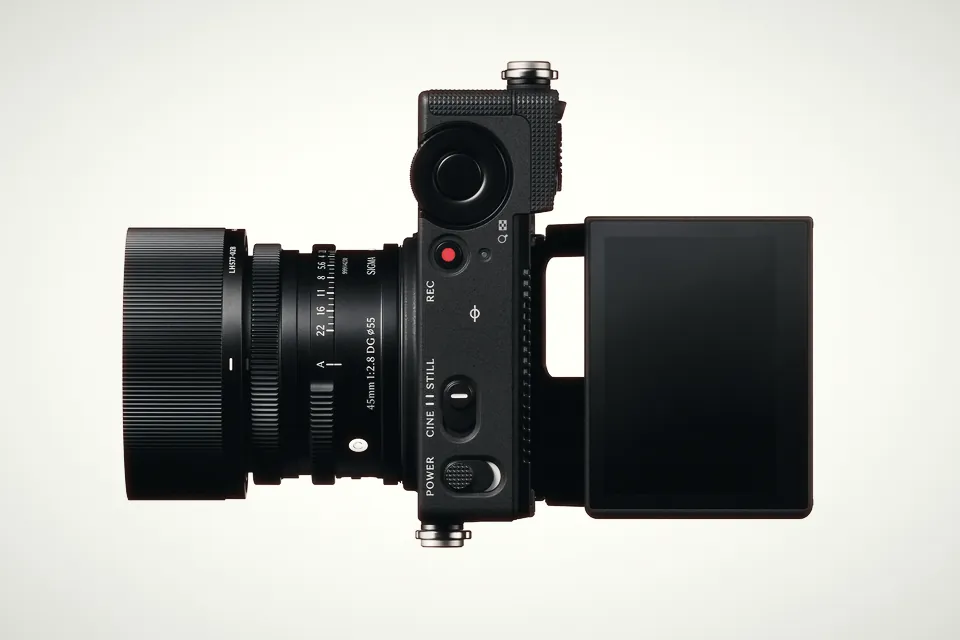
Sigma FP2: price, specs and everything that changed from the original fp
Sigma's FP2 adds phase-detect AF, 6K open gate, ProRes RAW and a tilting screen to a pocket full-frame body. Specs, price and what it means for video.
Sigma's first CL lens packs f/1.4 into 375 g and 56 mm. We compare its size with other 50mm lenses, explain the new RDD autofocus and what it means for video.
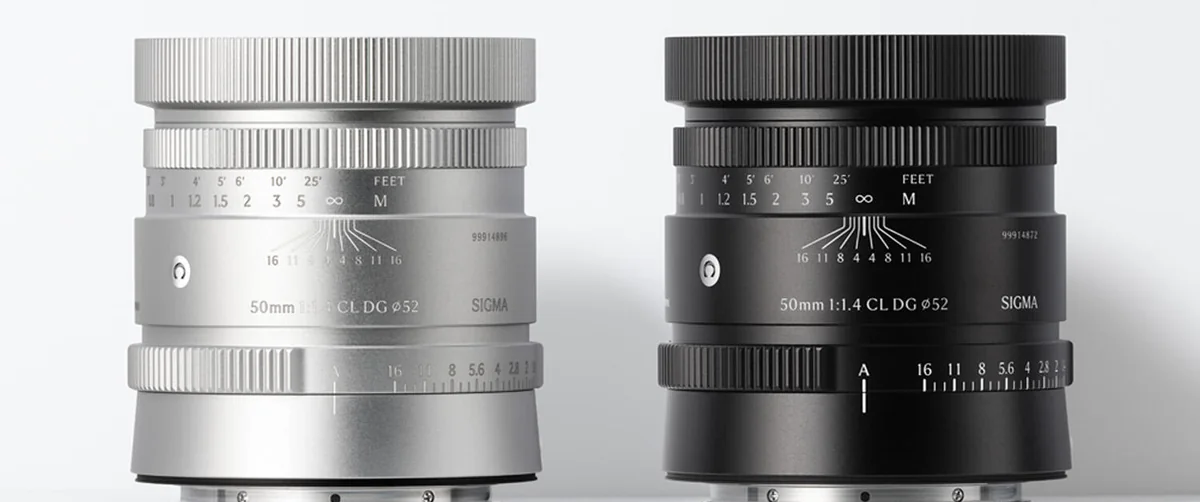
Sigma has announced the 50mm F1.4 CL DG | Contemporary, the first lens in a new compact line it calls the I series. It packs an f/1.4 full-frame prime into an all-metal barrel 56 mm long and 375 g heavy, and it moves its optics with a new autofocus motor called RDD. It ships in early spring 2027 for Sony E and L-Mount, in black or silver. Price is still to be announced.
Here is what is actually new, how it compares in size with the 50mm lenses you may already own, and what it means if you shoot video as well as stills.
| Format | Full frame, angle of view 46.8° |
|---|---|
| Aperture | f/1.4 to f/16, 14 rounded blades, aperture ring |
| Optics | 9 elements in 6 groups (1 FLD, 3 aspherical) |
| Focus | RDD autofocus, whole-lens extension, 0.45 m minimum, 1:6.8 max magnification |
| Size | ø64.7 × 56.0 mm (Sony E), 54.0 mm long on L-Mount |
| Weight | 375 g |
| Filter | 52 mm |
| Build | All metal, dust and splash resistant, water and oil repellent front element |
| Extras | Metal hood, magnetic metal cap, distance and depth-of-field scales |
| Mounts | Sony E, L-Mount, in black or silver |
| Release | Early spring 2027, price to be announced |
Fast 50s have grown huge in the mirrorless era. Sigma’s own 50mm F1.4 DG DN Art is around 111 mm long and 660 g; Sony’s 50mm F1.4 GM is 96 mm and 516 g. Sharpness from corner to corner at f/1.4 takes a lot of glass.
The CL goes the other way. At 56 mm it is shorter than Sony’s budget FE 50mm F1.8 and shorter than Sigma’s own 50mm F2 DG Contemporary, while gathering a full stop more light than the F2. The drawing below puts them side by side at the same scale.
| Lens | Diameter × length | Weight | Filter |
|---|---|---|---|
| Sigma 50mm F1.4 CL DG | 64.7 × 56 mm | 375 g | 52 mm |
| Sony FE 50mm F1.8 | 68.6 × 59.5 mm | 186 g | 49 mm |
| Sigma 50mm F2 DG Contemporary | about 70 × 68 mm | about 350 g | 58 mm |
| Sony FE 50mm F1.4 GM | 80.6 × 96 mm | 516 g | 67 mm |
| Sigma 50mm F1.4 DG DN Art | 78.2 × about 111 mm | about 660 g | 72 mm |
Notice the weight column. The CL is short, not featherweight: the metal barrel makes it about twice as heavy as the plastic-bodied Sony F1.8. What you save is length and bulk, which is what decides whether a camera fits in a jacket pocket or balances on a small gimbal.
To keep the lens short, Sigma moves the whole optical block to focus instead of a small group inside the lens, the way classic manual 50s did. The catch is weight: pushing all the glass needs much more force than the light focus groups in modern lenses.
Sigma’s answer is the RDD, short for Rotary Direct Drive. It uses the same ingredients as Sigma’s linear HLA motors, magnets and coils, but arranges them in a ring that follows the round barrel. According to Sigma, this gives a slim mechanism with high torque that barely adds to the lens diameter.
Two practical details. There is no AF/MF switch: turn the focus ring while autofocus is on and the lens hands over to manual focus. And the focus ring moves together with the focusing, which is what makes the printed distance and depth-of-field scales useful.
Early coverage suggests the trade-off is speed. Newsshooter notes that the RDD is slower than Sigma’s HLA systems and less suited to video autofocus, and SonyAlphaRumors reports it as fine for stills. Independent tests will tell how much slower.
Sigma is open about the look. In its announcement it says aberrations were “intentionally controlled to achieve a gentle softness within the in-focus plane”, with smooth bokeh and the rendering tuned for f/1.4. Fourteen rounded blades should keep out-of-focus highlights round when you stop down.
In other words, this is not a lens for test charts. Expect a softer glow wide open and, as DPReview expects, softer corners. For portraits, interviews and narrative work that is often a feature: it takes the digital edge off skin and backgrounds without a diffusion filter.
Sigma says early spring 2027, from authorised dealers. Some retailers already list it for pre-order.
Sigma had not announced a price at launch on 23 October 2026. We will update this article when it does.
Rotary Direct Drive. It is an autofocus motor whose magnets and coils are arranged in a ring around the barrel, giving the torque needed to move the whole optical block while keeping the lens slim.
Sony E-mount and L-Mount, each in black or silver. The L-Mount version is slightly shorter, 54 mm against 56 mm.
Its size, 52 mm filter thread and manual focus feel suit video well. Early reports describe the autofocus as slower than Sigma’s HLA lenses, so if you depend on continuous AF while filming, wait for hands-on tests.
Sigma's FP2 adds phase-detect AF, 6K open gate, ProRes RAW and a tilting screen to a pocket full-frame body. Specs, price and what it means for video.

Why 1/50 at 24 fps looks like cinema, how to keep it in bright daylight, and the moments when a different shutter angle tells the story better.
 CamerasNew bodies, firmware updates and what they change on set.
 LensesPrimes, zooms and anamorphics, with the look they give.
 SoftwareEditing, grading and VFX tools, and the updates worth installing.
 AccessoriesGimbals, monitors, audio, lights and the small things that save a shoot.
 TipsTechniques and tutorials, from exposure to storytelling.