
DJI Neo 3 leaks: bigger sensor, 192.7 g and everything we know before launch
Leaks point to a 1/1.1-inch square sensor, 192.7 g and an RC Mini remote for the DJI Neo 3. What's confirmed, what isn't, and when it could launch.
At native ISO 1600 in D-Log 2, the Osmo Pocket 4P needs about 11 stops of ND in full sun. Most Pocket ND kits stop at 6 to 8. The maths, and what to buy.
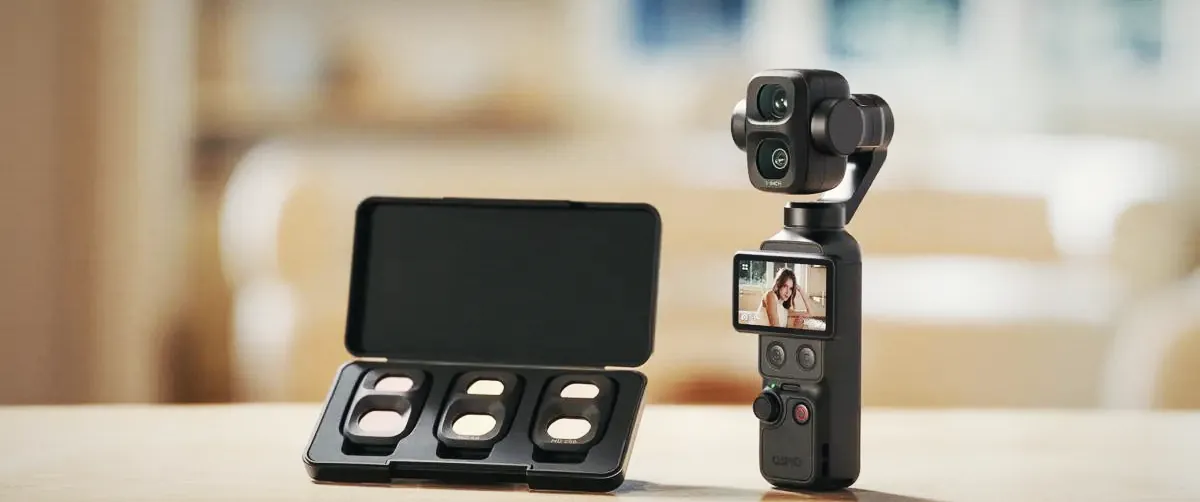
CineD's lab measured the Osmo Pocket 4P's wide camera at native ISO 1600 in D-Log 2, and that's where it got 16 stops of dynamic range. Shoot at ISO 1600 in full sun at f/2.0 and a 180° shutter, and the exposure maths says you need about 11 stops of ND. DJI's own set tops out at ND256, which is 8 stops, and most variable NDs sold for the Pocket stop at 5 to 7.
The filters most people buy for a Pocket 4P make sense at ISO 100. If you want the full highlight range of D-Log 2 outdoors, you'll need something stronger, or you'll have to give some of that range back.
DJI doesn't print a native ISO on its spec page. It lists a video range of ISO 100 to 25600 for the wide camera and 50 to 12800 for the 60mm. The useful number comes from CineD's lab test, published on 30 July 2026, which gives a native ISO for each camera and ran its dynamic range test there.
| Camera | Aperture | Log profile | Native ISO | Dynamic range (SNR 2 / SNR 1) |
|---|---|---|---|---|
| 20mm wide | f/2.0, fixed | D-Log 2, 10-bit | 1600 | 16 / 17.2 stops |
| 60mm medium tele | f/1.8, fixed | D-Log | 400 | 11.6 / 12.9 stops |
The aperture is the part that makes this an ND question. Neither lens has an iris you can close down, so CineD had to use ND filters to underexpose its test chart. On the Pocket, your shutter speed and your ND are the only ways to cut light once ISO is set.
You give up highlight room. Gamut, which profiles log curves for its LUTs, references the D-Log 2 white clipping point to ISO 1600, where it sits at about 94 IRE. Each step down in ISO lowers it, until ISO 100 clips at around 70 IRE. Middle grey stays at about 31 IRE, so the space between grey and white shrinks as you go down.
| ISO | White clip | What it means on a sunny day |
|---|---|---|
| 1600 | about 94 IRE | Full highlight range. Needs the most ND |
| 400 | between the two | A compromise: 2 stops less ND, some headroom lost |
| 100 | about 70 IRE | Least ND, skies and specular highlights clip sooner |
Some guides tell you the opposite. Freewell's own Pocket 4P settings guide suggests D-Log 2 at ISO 100 for daytime. That's a fair choice if the scene has no bright sky or reflections, and it's the setting those 2-to-7-stop filters were made for. If you bought the 4P for the dynamic range CineD measured, though, ISO 1600 is the number that gets you there.
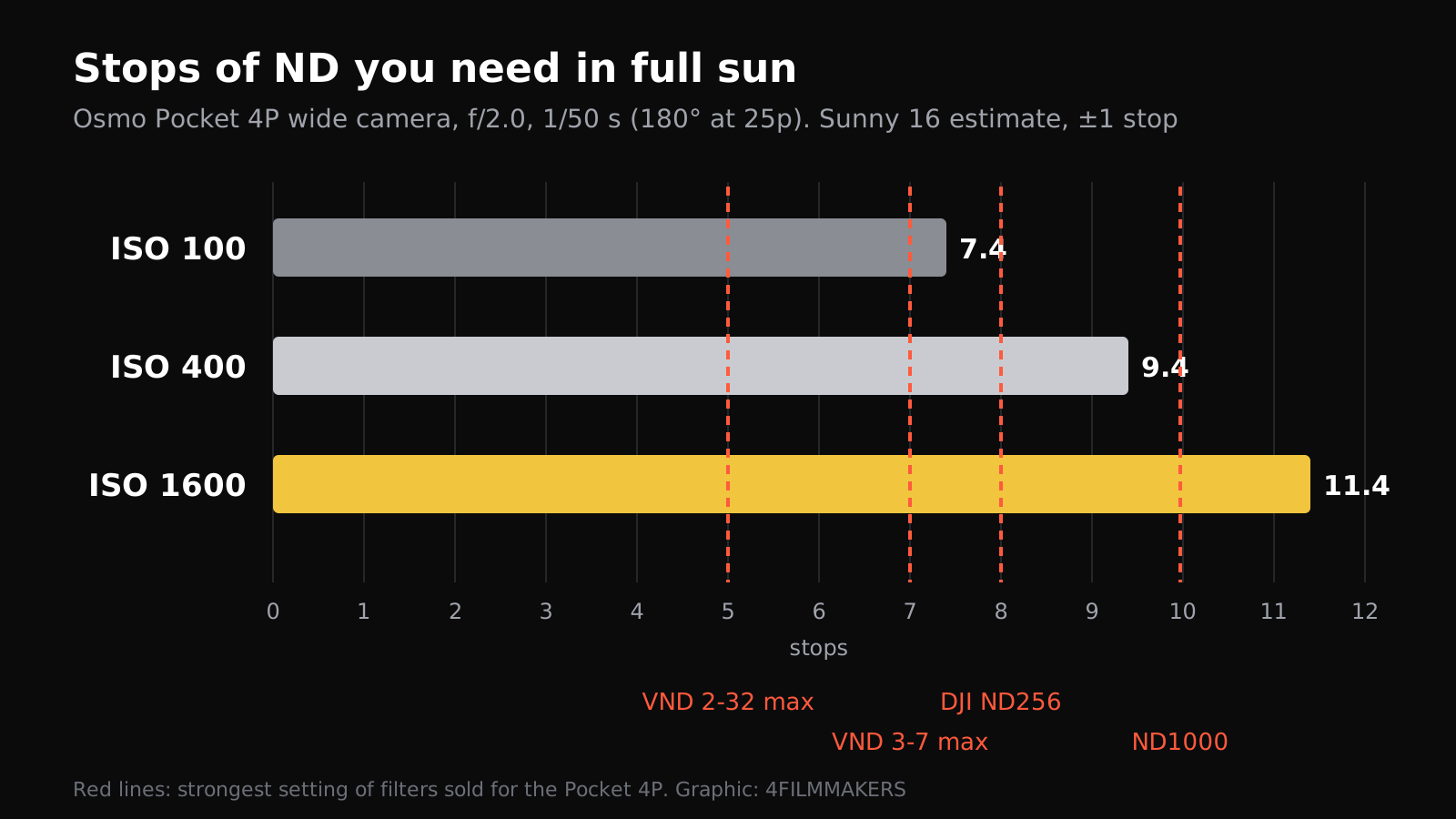
We used the sunny 16 rule: in direct sun, a correct exposure is f/16 at 1/ISO. The Pocket's wide lens is f/2.0, which lets in 6 stops more light than f/16. Add the shutter you want and the ISO you chose, and the gap is the ND you need. These figures are estimates. Real scenes move by a stop either way, and snow, sand or water add one more.
| Light | ISO 100, 1/50 | ISO 400, 1/50 | ISO 1600, 1/50 | ISO 1600, 1/100 (50p) |
|---|---|---|---|---|
| Sun on snow, sand or water | 8.4 (ND256+) | 10.4 (ND1000+) | 12.4 (ND4000+) | 11.4 (ND2000+) |
| Full sun | 7.4 (ND128) | 9.4 (ND512) | 11.4 (ND2000+) | 10.4 (ND1000+) |
| Hazy sun | 6.4 (ND64) | 8.4 (ND256) | 10.4 (ND1000+) | 9.4 (ND512) |
| Overcast | 5.4 (ND32) | 7.4 (ND128) | 9.4 (ND512) | 8.4 (ND256) |
| Heavy overcast, open shade | 4.4 (ND16) | 6.4 (ND64) | 8.4 (ND256) | 7.4 (ND128) |
For 30p, use 1/60 instead of 1/50 and take a quarter of a stop off. For 50p and 60p the right-hand column is close enough.
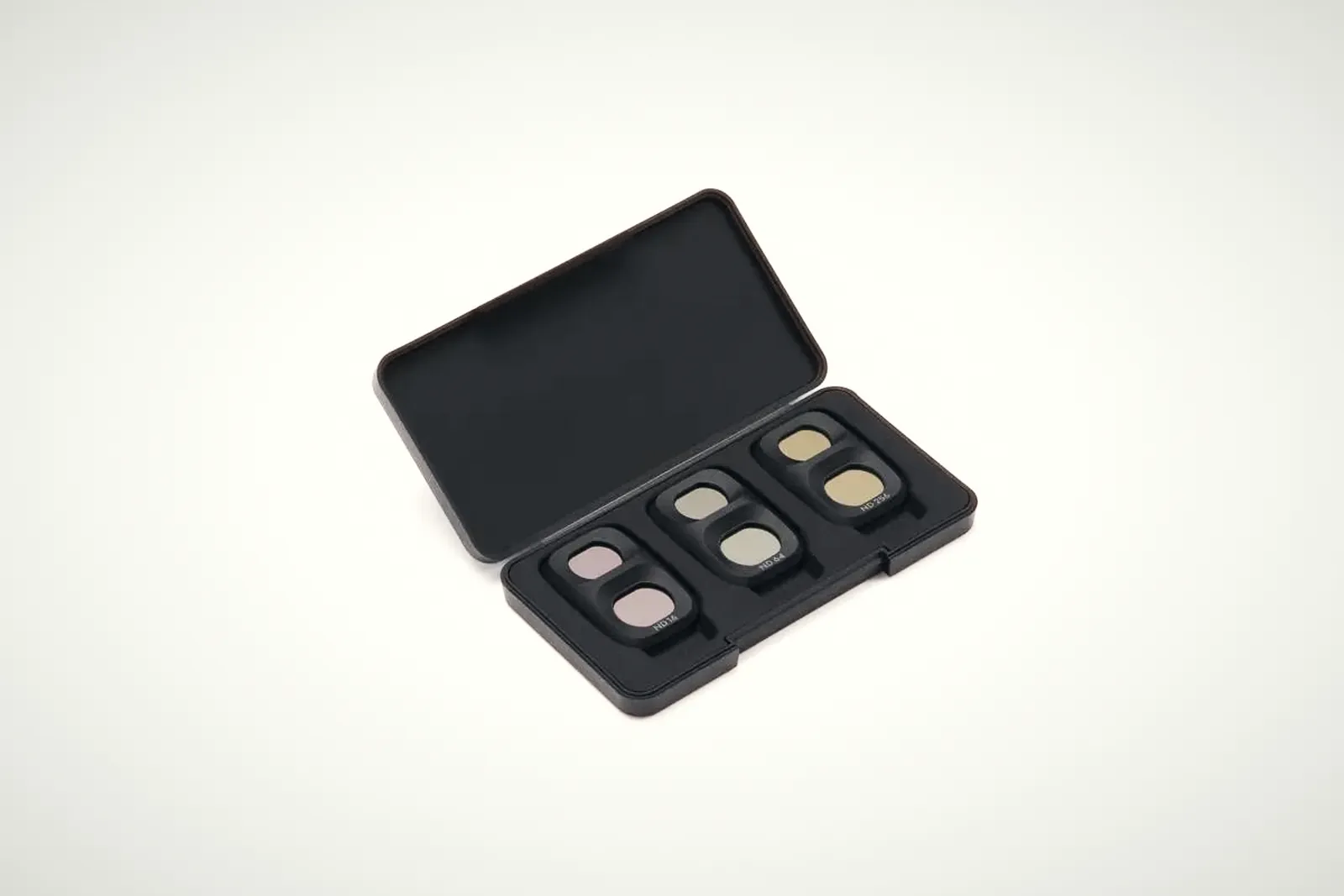
These are the ND options we found made for the 4P's twin-lens front. Freewell lists prices in US dollars on its own store, so we've given those, plus euro prices where European shops list them.
| Filter | Strengths | Strongest | Price |
|---|---|---|---|
| DJI ND Filter Set | ND16, ND64, ND256 | 8 stops | €49 DJI Store, £39 at Wex |
| Freewell Standard Day, 4 pack | ND8, ND16, ND32, ND64 | 6 stops | $49.99 on sale ($69.99 list) |
| Freewell Super Bright Day, 3 pack | ND128, ND256, ND512 | 9 stops | $49.99 on sale ($69.99 list) |
| Freewell ND1000 | ND1000 | about 10 stops | $19.99, about €24 to €25 in EU shops |
| Freewell VND 3-7 | variable, 3 to 7 stops | 7 stops | $49.99 |
| Neewer filter set | ND16, ND64, ND256 + CPL, or VND 2-32 + CPL + diffusion | 8 stops (VND: 5) | €49.99 Neewer EU |
We couldn't find a Pocket 4P filter maker that says its filters can be stacked, so plan on one filter at a time. Freewell sells the ND1000 as a long-exposure filter. We haven't seen published tests of its colour on video, so shoot a test clip with a grey card before you rely on it for a job.
A variable ND's whole selling point is that you turn a ring instead of swapping glass. On a Pocket 4P at ISO 1600, the range sits in the wrong place. Freewell's VND 3-7 reaches 7 stops at its darkest, and Neewer's VND 2-32 reaches 5. In full sun you need 11.4. At the darkest setting you're still 4.4 stops over with the Freewell, which forces the shutter up to around 1/1000 at 25p and gives you the choppy motion you bought the filter to avoid.
The same goes for ND8 to ND64 kits. At ISO 1600 an ND64 covers dusk and deep shade. Those filters do their job at ISO 100, and that's how Freewell and others pitch them, with ND8 labelled for daylight.
| Option | Good | Bad |
|---|---|---|
| Variable ND (2-32, 3-7) | One filter, fast to adjust, fine at ISO 100 | 4 to 6 stops short in full sun at ISO 1600 |
| DJI ND16/64/256 | Cheap, made by DJI, covers both lenses | ND256 only reaches shade and heavy overcast at ISO 1600 |
| Freewell ND128/256/512 | Right range for overcast and hazy days at ISO 1600 | Still 2.4 stops short in full sun at 1/50 |
| ND1000 | Closest to full sun at ISO 1600, cheap | 1.4 stops short at 1/50, colour on video untested by us |
The 60mm camera doesn't shoot D-Log 2. CineD tested it in D-Log at native ISO 400. That's 2 stops less sensitive than the wide camera at 1600, and its f/1.8 lens lets in about a third of a stop more light. Net result: at their native ISOs the tele needs about 1.7 stops less ND than the wide. DJI's filter frame covers both lenses, so if you cut between them on the same shot list, one ND will leave one camera off by almost two stops. Pick the filter for the camera you'll use most and fix the other with shutter.
Zoom matters too. DJI's footnotes say 10-bit D-Log 2 only works at 1x zoom. Push in past 1x on the wide camera and you're out of D-Log 2, so the ISO 1600 logic above applies only to the native 20mm view.
| If you shoot | Get | Why |
|---|---|---|
| D-Log 2 at ISO 1600, mostly sunny days | ND1000, plus 50p at 1/100 when you can | Within half a stop of 180° in full sun at 50p |
| D-Log 2 at ISO 1600, cloudy Northern European weather | ND256 and ND512 (Freewell Super Bright Day) | Overcast needs about 9.4 stops, shade about 8.4 |
| D-Log 2 at ISO 400 as a compromise | DJI set plus an ND512 | Full sun needs about 9.4 stops |
| ISO 100, or HLG and normal colour | DJI set or a VND 3-7 | Full sun needs about 7.4 stops |
| Vlogging with auto exposure | Nothing, or a light ND for slower shutter | The camera handles exposure. 180° matters less to you |
Our view: if you shoot D-Log 2 on sunny days, an ND1000 at around €25 is the most useful Pocket 4P filter you can buy, and none of the ND-only kits we found include it. Pair it with the ND256 from DJI's set for cloud and shade. If you'd rather not carry the extra filter, drop to ISO 400 on bright days and accept that the sky will clip a little sooner.
All of this applies to the Pearl White Osmo Pocket 4P as well, since it has the same sensor and takes the same filters. If you grade D-Log 2 in Resolve, our piece on DaVinci Resolve 21.1.2 covers the latest version and the Studio sale.
CineD's lab test lists native ISO 1600 for the 20mm wide camera in D-Log 2 and ISO 400 for the 60mm camera in D-Log. DJI doesn't publish a native ISO on its spec page.
At ISO 1600, f/2.0 and 1/50 s, full sun needs about 11.4 stops, more than any Pocket 4P filter we found. An ND1000 gets you within 1.4 stops. At ISO 100 you need about 7.4 stops, so an ND128 or ND256 is enough.
At ISO 100 it's handy. At ISO 1600 in D-Log 2 the variable NDs sold for the Pocket, 2 to 5 stops and 3 to 7 stops, can't get you to a 180° shutter outdoors in daylight.
ISO 1600 keeps the most highlight range: Gamut puts the white clip at about 94 IRE there and about 70 IRE at ISO 100. ISO 100 needs 4 stops less ND, so it's easier in sun if the scene has no bright sky or reflections.
No. According to DJI's footnotes, 10-bit D-Log 2 only supports 1x zoom. The 60mm camera records D-Log, not D-Log 2.
Leaks point to a 1/1.1-inch square sensor, 192.7 g and an RC Mini remote for the DJI Neo 3. What's confirmed, what isn't, and when it could launch.
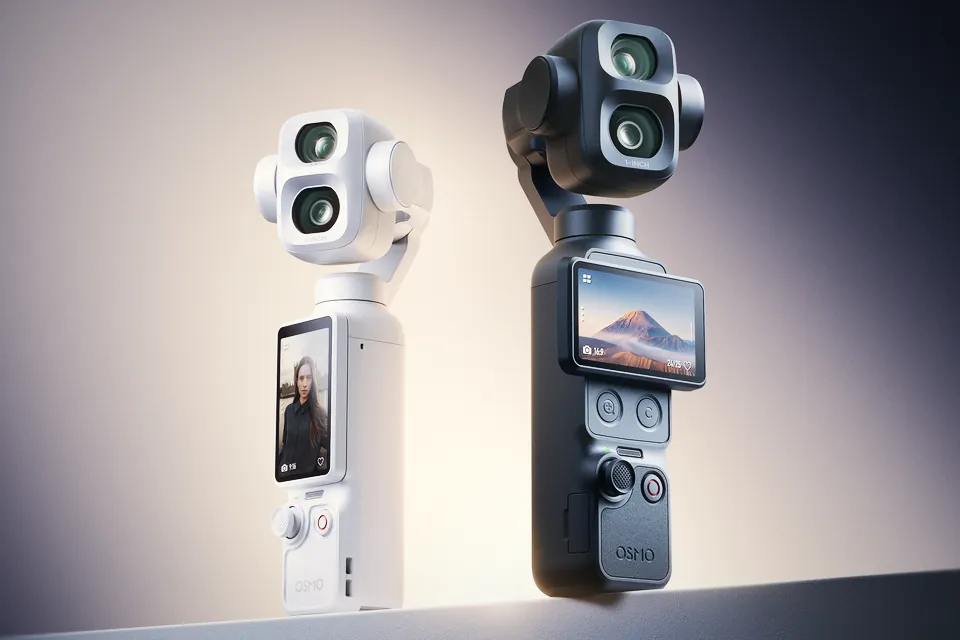
The Osmo Pocket 4P now comes in Pearl White, with white accessories in the box. Same specs and price as the black one. Where to buy it and what to know first.
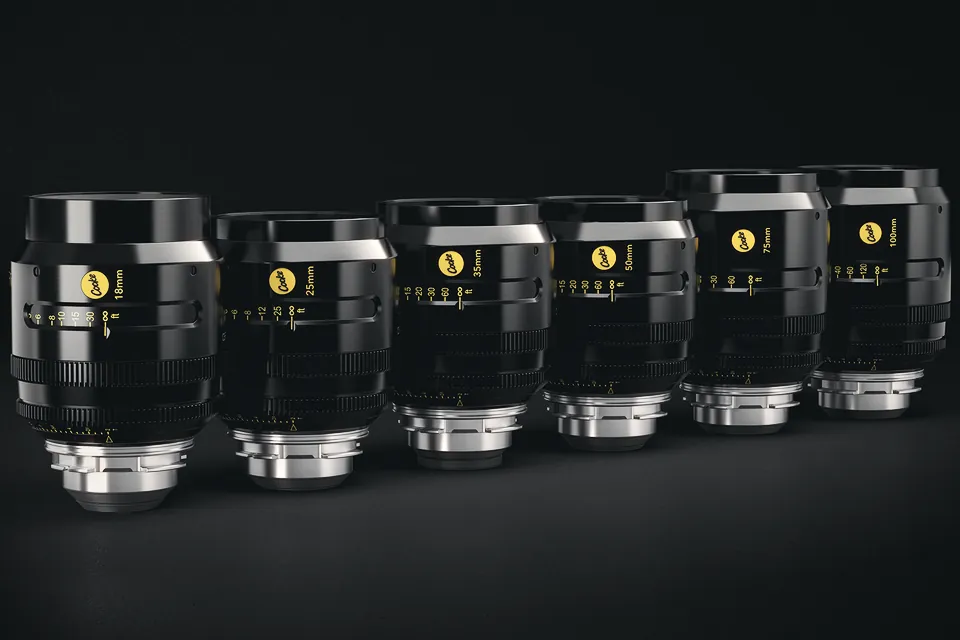
Cooke's S4 FF/i brings the S4 look to full frame: six T2 primes from 18 to 100mm at $15,000 each. Official specs, price and what changed from the S4/i.
 Cameras & dronesNew bodies, drones, firmware updates and what they change on set.
 AccessoriesLenses, gimbals, monitors, audio, lights and the gear around the camera.
 LeaksRumours and leaked specs before launch, with what is confirmed and what is not.
 SoftwareEditing, grading and VFX tools, and the updates worth installing.
 OtherIndustry news, techniques and everything that does not fit a box.