Laowa 24mm f/2 Tilt-Shift for video: the ±10° catch and who should buy it
Laowa's f/2 tilt-shift lists ±10° of tilt, but past 5 m you get ±3° or ±4°. What that means for video, the Lumix bodies it skips, and who should buy it.
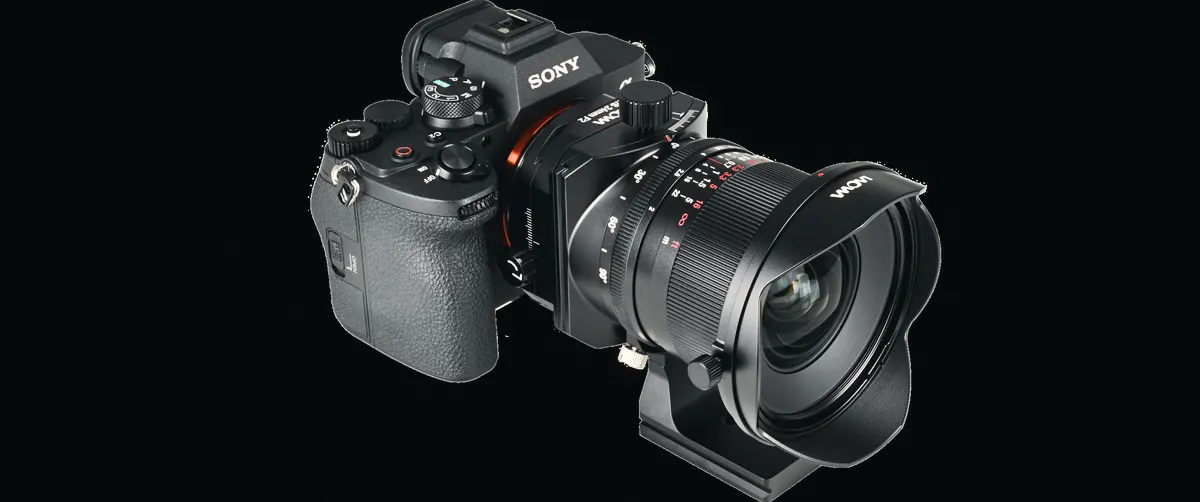
The Laowa 24mm f/2 Zero-D Tilt-Shift on a Sony body. Image: Laowa / Venus Optics, graded by 4FILMMAKERS.
The Laowa 24mm f/2 Zero-D Tilt-Shift is a fully manual full-frame lens that Venus Optics launched this week at $1,249, in Sony E, Nikon Z, Canon RF, L-mount, GFX and XCD. Laowa calls it the fastest tilt-shift lens made for any format. The ±10° of tilt only applies from 25 to 40 cm, though: past 5 m you get ±3° with full shift, or ±4° with half.
Launch coverage has stuck to architecture and stills, and Videomaker says most video shooters won't reach for a tilt-shift often. That's fair. If you're one of the few who will, you need Laowa's tilt table, the maths on what those degrees do to your focus plane, and a list of what Laowa hasn't published.
Laowa 24mm f/2 Tilt-Shift specs at a glance
Figures from Venus Optics unless noted
Spec
Laowa 24mm f/2 Zero-D Tilt-Shift
Format
Full frame, with GFX and XCD versions
Aperture
f/2 to f/22, 14 blades, manual ring (Videomaker)
T-stop
Not published
Tilt
Up to ±10°, depending on focus distance
Shift
±12mm
Rotation
360°
Image circle
67mm (DPReview, Newsshooter; not on Laowa's spec table)
Optics
13 elements in 10 groups
Close focus
25 cm, 0.194× magnification
Focus
Manual
Filter thread
77 mm
Size and weight
Ø93 × 119 mm, 860 g
Price
$1,249 on Laowa's store (Newsshooter quotes $1,224). No euro or sterling price found
How much tilt do you get at each distance?
Laowa's table ties tilt to focus distance. Full-frame mounts get less than GFX and XCD at anything past 50 cm, and DPReview notes that more tilt leaves you less shift, and the other way round.
Maximum tilt from Laowa's product page, with the shift available at that tilt
Focus distance
E, Z, RF, L
GFX, XCD
Infinity to 5 m, full shift
±3° with ±12mm
±4° with ±12mm
Infinity to 5 m, half shift
±4° with ±6mm
±5° with ±6mm
1.5 m
±4° with ±12mm
±5° with ±12mm
1 m
±5° with ±12mm
±5.5° with ±12mm
0.5 m
±8° with ±12mm
±8° with ±12mm
0.4 to 0.25 m
±10° with ±12mm
±10° with ±12mm
The table has no row for zero shift, so we can't tell you what you'd get past 5 m with the shift centred. Try it on the lens itself before you plan a shot around it.
What does 3° of tilt do to your focus plane?
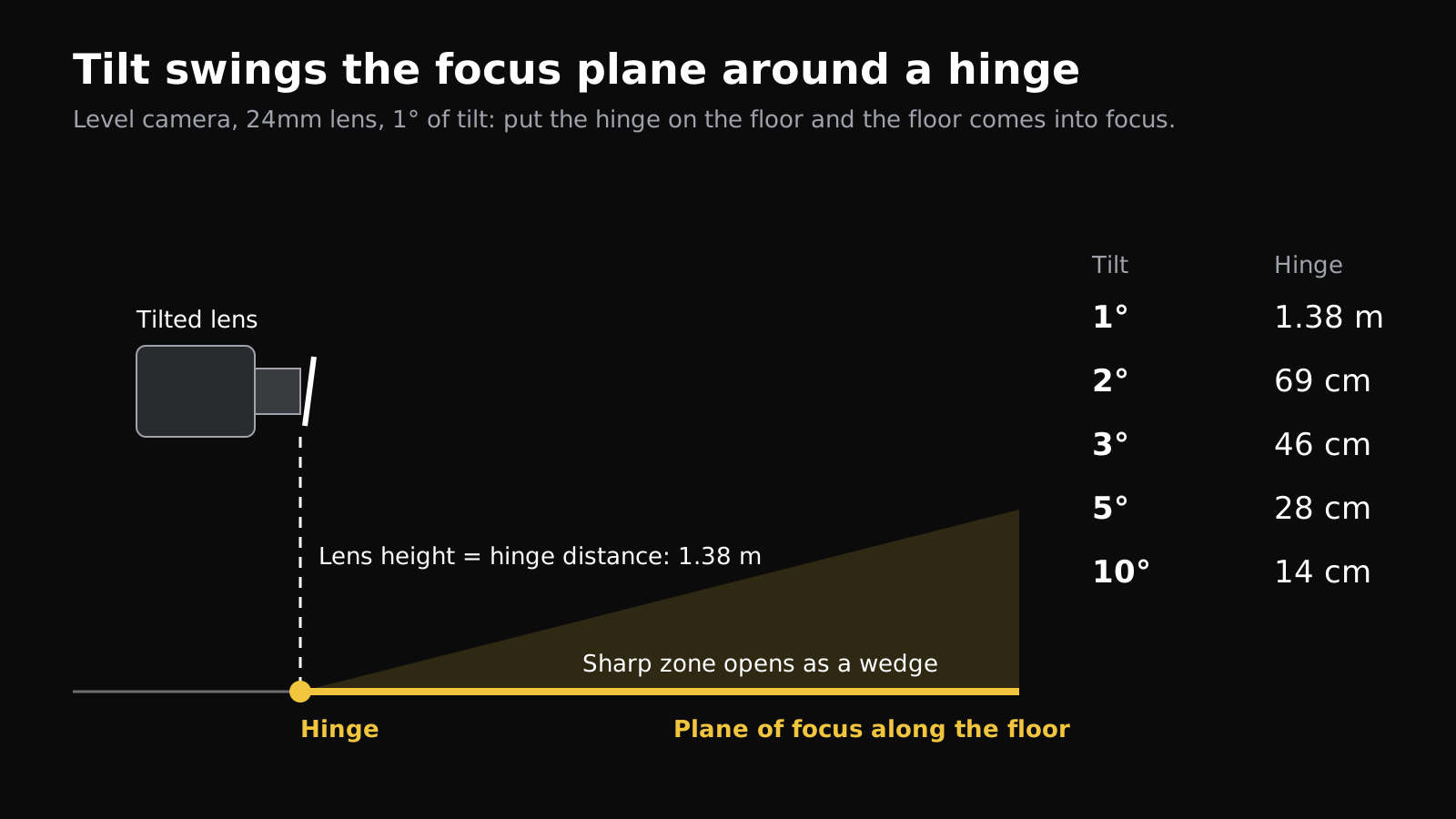
More than the number suggests. Tilt swings the plane of focus around a hinge line, and on a 24mm lens that hinge sits close to the camera. Hinge distance is focal length divided by the sine of the tilt angle, so you can work out a shot before you unpack. Point a level camera, put the hinge on the surface you want sharp, and the plane runs along that surface.
Our maths for a 24mm lens, using the standard hinge rule. Graphic: 4FILMMAKERS.
Hinge distance on a 24mm lens, measured from the lens, level camera (our maths)
Tilt
Hinge distance
Shot it suits
1°
1.38 m
Tripod height over a floor, sharp into the distance
2°
69 cm
Level camera about 70 cm above a table
3°
46 cm
Hi-hat or slider about 46 cm above a floor
5°
28 cm
Lens 28 cm above a table, product around 1 m away
10°
14 cm
Close-up product work, focused at 25 to 40 cm
The ±3° limit past 5 m costs you little on floor and table shots. It hurts if you want the opposite effect: tilting against the scene for the miniature look, where more tilt gives a thinner slice of focus.
The sharp zone is a wedge that opens from the hinge, as Fstoppers describes in its review of Laowa's 35mm tilt-shift. Its half-height at a given distance depends on tilt and f-stop:
Depth above and below the plane of focus at 10 m on a 24mm lens (our maths, 0.03 mm circle of confusion)
Tilt
At f/2
At f/3.5
1°
±1.43 m
±2.51 m
3°
±0.48 m
±0.84 m
4°
±0.36 m
±0.63 m
A person 10 m away stands about 1.7 m tall, so at 3° and f/2 you can hold head and shoulders and lose the feet. Stop down to f/3.5 and you'd need about 5° for that slice, which this lens doesn't offer out there. For video, that's the best argument for f/2. These figures are geometry and ignore lens aberrations, and we found no published test at f/2 yet.
What else does f/2 give you on a shoot?
Laowa says the lens opens about 1.6 stops wider than other 24mm tilt-shifts, and the maths agrees. At the same shutter and frame rate, ISO 1600 at f/2 matches about ISO 4900 at f/3.5. That matters on real estate walkthroughs at dusk, in churches and in any interior you can't light. T-stop decides the true exposure, though, and Laowa hasn't given one.
Does shift reach the corners in 16:9?
Yes, on paper. We worked out how wide an image circle each format needs at the full ±12mm:
Image circle needed at ±12mm of shift, against the reported 67mm (our maths)
Recording area
Shift sideways
Shift up or down
Full frame open gate, 36 × 24 mm
64.6 mm
60 mm
Full frame 16:9, 36 × 20.25 mm
63.3 mm
57 mm
Super 35 16:9, about 23.4 × 13.2 mm
49.2 mm
43.9 mm
Full frame fits with 2 to 4 mm to spare, and Laowa itself warns of mild corner vignetting at maximum shift. Expect to see that in a flat log image once you grade it. Super 35 stays well inside the circle, and on an FX30 or A6700 the lens frames like a 36mm.
Laowa's own claims don't sit well with that 67mm, though. It promises ±12mm on medium format with no dark corners, and by our maths that needs about 75 mm of coverage on a 44 × 33 mm sensor. Treat 67mm as a reported figure until Laowa prints one. Its listed 102.7° and 90° angles of view also describe the lens at full shift: unshifted on full frame, 24mm gives about 74° across and 53° down.
For video, shift's main job is straight verticals. You keep the camera level in a tall room and slide the lens to frame, so you don't lose pixels to a keystone fix in Resolve. If you shoot 6K for a 4K delivery, you have room to do that fix in post, and the lens gets harder to justify.
Which video cameras does it skip?
Laowa's mount list includes L-mount, but its page says the lens doesn't fit the Lumix S5II, S5IIX, S1II, S1IIE or S1RII (it writes them S52, S52X, S1M2, S1M2E and S1R2). That covers Panasonic's recent full-frame bodies. Newsshooter printed the same exclusion for Laowa's 35mm tilt-shift, and Laowa doesn't explain either one. If you're on Lumix, ask the seller before you order. Sony E, Nikon Z and Canon RF carry no such note.
Laowa 24mm f/2 vs Canon TS-E 24mm and Samyang T-S 24mm
The closest 24mm tilt-shifts. Canon and Samyang tilt and shift come from retailer and review listings, and retailer prices carry no date
Laowa 24mm f/2
Canon TS-E 24mm f/3.5L II
Samyang T-S 24mm f/3.5
Aperture
f/2
f/3.5
f/3.5
Tilt
±10°, ±3° to ±4° at distance
±8.5°
±8.5°
Shift
±12mm
±12mm
±12mm
Weight
860 g
780 g
680 g
Filter
77 mm
82 mm
82 mm
Mirrorless use
Native E, Z, RF, L
EF, needs an adapter
Depends on the mount you buy
Price
$1,249
1826€ at Objektivwelt, £1,999 at Wex
Launched at $1,299 and £949, current price not checked
Best for
Low light, thin slices of focus
Canon crews with EF glass, known results
Tight budgets, if you can find one
Nikon's PC-E 24mm f/3.5D ED is an F-mount lens at about 730 g with 77 mm filters, and it offers electronic aperture control. Laowa's own 35mm f/2.8 tilt-shift costs the same $1,249 and reaches 0.5×, at 1.35 kg. For product and food work that may suit you better than the 24mm.
What should you check before rigging it?
Video details missing from the launch material as of 6 November 2026
Question
What we found
Why you care
T-stop
Not published
Matching exposure with your other primes
Focus gear
None mentioned, no cine version in Laowa's menu
You'd need a clamp-on gear ring for a follow focus
Focus throw
Not published
A short throw makes pulls hard at f/2
Focus breathing
No data
Tilted pulls already move the plane in odd ways
Aperture clicks
Not stated
Clicked rings show up in a mid-shot exposure change
Electronic contacts
Not listed, Videomaker calls it fully manual
Without them, enter 24mm in your IBIS menu by hand
Separate tilt and shift axes
Laowa lists 360° rotation only
Fstoppers says the axes are locked together on the 35mm
Some practical points follow from the design. Shift moves the lens's weight off-centre, so expect to rebalance a gimbal for every change, and at 860 g it's a tripod and slider lens anyway. The front of the lens moves too, so a rod-mounted matte box with a tight donut may foul it; screw-in filters on the 77 mm thread are simpler. If you own an 82 mm variable ND, as we suggest in our variable ND guide, a 77-82 step-up ring will carry it, but watch the corners at 24mm with the lens shifted.
There's no autofocus, so turn peaking on: it shows you where the tilted plane falls. Our Sigma 50-120mm video checklist covers the same barrel and filter questions for a very different lens.
What it means for filmmakers: who should buy it?
Our read, based on specs and not on a test
You shoot
Our call
Why
Interiors and architecture on a tripod, in dim light
Buy or rent
f/2 plus straight verticals, and no other 24mm tilt-shift goes this wide
Stylised music videos and ads with a thin slice of focus
Rent first
f/2 helps most here, but the distance limit bites
Tabletop products and food
Compare with the 35mm
Tilt is at its best up close, and the 35mm gets closer
Canon EF with a TS-E 24mm already
Keep it unless you need f/2
It's 1.6 stops slower, but you've already paid for it
Lumix S5II, S5IIX, S1II family
Don't order it
Laowa lists these bodies as not compatible
Handheld or gimbal, run and gun
Skip it
Manual focus, 860 g, and a shifting centre of gravity
Pros and cons for video
What convinces us
What gives us pause
f/2, where other 24mm tilt-shifts stop at f/3.5
No T-stop, no gear, no throw figure
Native mounts, no EF adapter
Five Lumix bodies excluded
Enough tilt for floor and table shots
±3° to ±4° past 5 m limits the miniature look
$1,249, against $1,949 for the Canon at launch in 2009
No European price yet
Buying in Europe is the open question. SonyAlphaRumors lists pre-orders at Fotokoch, Foto Erhardt, Calumet, Wex and Clifton, Newsshooter says the lens is available now, and Camera Jabber wrote on 2 November that UK pricing and a global date weren't confirmed. We couldn't find a listing with a euro or sterling price today, so check before you budget for it.
Laowa 24mm f/2 questions people ask
How much is the Laowa 24mm f/2 Tilt-Shift?
Laowa's store and DPReview list $1,249, Newsshooter quotes $1,224, and the China price is RMB 7,650. We found no euro or sterling price on 6 November 2026.
Does the Laowa 24mm f/2 Tilt-Shift work on the Lumix S5II?
No. Laowa says the lens isn't compatible with the S5II, S5IIX, S1II, S1IIE and S1RII, even though it sells an L-mount version. It doesn't give a reason.
Is there a cine version of the Laowa 24mm f/2 Tilt-Shift?
We found none. Laowa's cine menu doesn't list one, and the launch material doesn't mention a focus gear or a T-stop.
Does it have autofocus?
No. Focus is manual, and Videomaker describes rings for both focus and aperture.
How much tilt do I need for video?
Less than you'd think for floors and tables. On a 24mm lens with a level camera 1.5 m above the floor, about 0.9° puts the plane of focus on the floor. The miniature look takes more, and past 5 m this lens stops at ±3° or ±4°.
Can I use it on a Super 35 camera?
Yes, on E, Z, RF or L bodies. It frames like a 36mm on Sony Super 35, and shift stays well inside the image circle by our maths.