Taking a DJI Pocket 4P or Mini 5 Pro to the US: what the FCC import rule says
Bought a Pocket 4P or a DJI drone in Europe? The FCC import rule, the three-device personal exemption, FAA drone rules for visitors, and what's still unclear.
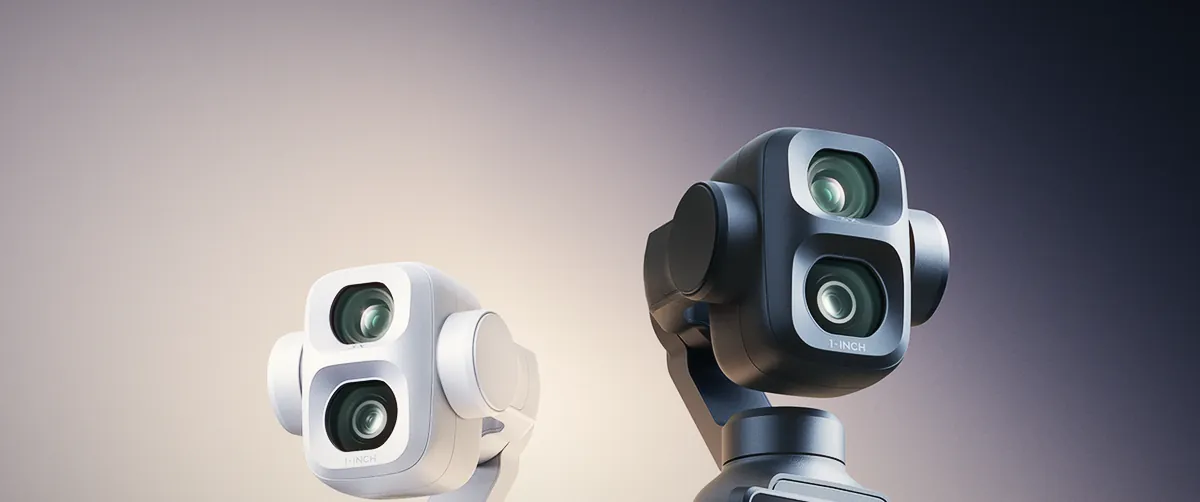
The Osmo Pocket 4P, sold in Europe since 30 July 2026 and still without FCC authorization. Image: DJI, graded by 4FILMMAKERS.
If your DJI camera or drone has an FCC ID, the US import rule lets you bring it in, and the FCC has repeated in 2026 that the Covered List doesn't stop anyone using gear they already own. The Osmo Pocket 4 and Pocket 4P have no FCC authorization. For them the only personal route is a three-device exemption in 47 CFR 2.1204(a)(7), written for a narrow set of radios, and neither the FCC nor US customs has said whether a traveller's Pocket 4P fits it.
We read the rule text on eCFR and the FCC notices in the Federal Register up to 10 November 2026. What follows is our reading for filmmakers who travel. It isn't legal advice.
Why can't you buy a Pocket 4P in the US?
On 22 December 2025 the FCC's Public Safety and Homeland Security Bureau added two things to the Covered List: every uncrewed aircraft system and UAS critical component "produced in a foreign country", and the communications and video surveillance equipment listed in section 1709 of the FY2025 NDAA. Section 1709 names DJI and Autel. Covered equipment can't get a new FCC equipment authorization, and in the US you can't legally import or market most radio devices without one.
The first rule catches every foreign-made drone. The second catches DJI hardware that isn't a drone, which is why a gimbal camera like the Pocket 4 got stuck. DJI launched it worldwide on 17 April 2026 and the Pocket 4P on 30 July, both without the US, and told reporters its applications were still pending. In its April brief to the Ninth Circuit, DJI counted 25 launches planned for 2026 that it can't bring to the US. The Osmo Action 6 skipped DJI's own US channels too.
DJI gear a traveller might pack, and where it stands in the US (10 November 2026)
Product
Launched
Sold by DJI in the US
FCC authorization
Osmo Pocket 3
2023
Yes
Yes, granted before the listing
Mini 5 Pro
2025
Authorized, US stock has been patchy
Yes, granted before the listing
Osmo Action 6
18 Nov 2025
No, DJI said it wouldn't sell it through its own channels
Check the label on your unit
Osmo Pocket 4
17 Apr 2026
No
No, DJI says pending
Osmo Pocket 4P
30 Jul 2026
No
No, DJI says pending
The legal fight hasn't settled anything yet. DJI asked the FCC to reconsider in January 2026 and sued in the Ninth Circuit in February (case 26-1029). On 16 October the FCC filed a renewed motion to dismiss the case as premature, since its own reconsideration is still open.
What does the US import rule allow?
47 CFR 2.1203 says no radio device enters the US unless the importer decides it meets one condition in 2.1204. For a traveller, the importer is you. Fail every condition and the rule allows "refused entry, refused withdrawal for consumption, required redelivery to the Customs port", plus civil and criminal remedies. You also have to be able to show, if asked within a year, how you decided the device complied.
The 2.1204(a) conditions that matter to someone carrying their own kit
Condition
What the rule says
Who it helps
(a)(1)
The device has a valid FCC equipment authorization that hasn't been limited under 2.939(e)
Pocket 3, Mini 5 Pro and other DJI gear authorized before December 2025
(a)(7)
Three or fewer devices for personal use, not for sale, and only from listed categories
Possibly a Pocket 4 or 4P, see below
(a)(8)
Imported for repair, not for sale
A unit going to a repair centre, not a holiday
Does the three-device exemption cover a Pocket 4P?
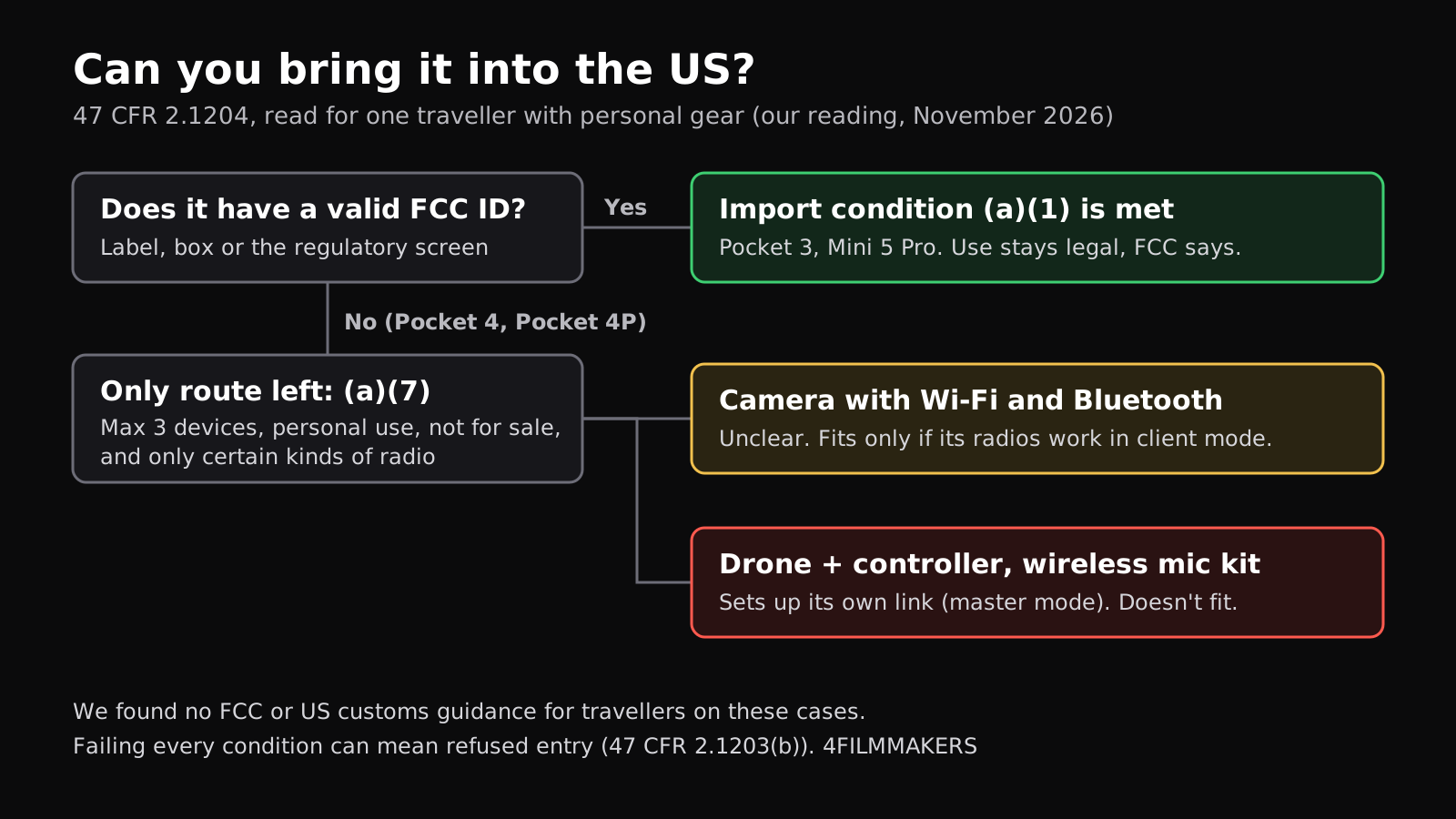
Paragraph (a)(7) accepts four kinds of device: unintentional radiators (receivers, computers), consumer ISM equipment, licensed transmitters run by a licensed operator, and Part 15 intentional radiators "only if they can be used in client modes". Section 15.202 defines a client as a device whose transmissions are "under control of the master" and that "is not able to initiate a network".
Our reading of 47 CFR 2.1204 for one person with personal gear. Graphic: 4FILMMAKERS.
A drone and its remote controller build their own video link, and a wireless mic transmitter does the same with its receiver. Under the 15.202 definition that's master behaviour, so an unauthorized drone or mic kit doesn't fit (a)(7) as written. A Pocket 4P talks to your phone over Wi-Fi and Bluetooth and can take a DJI Mic directly. DJI doesn't publish which side starts each link, and the FCC hasn't ruled on cameras like this one. For the Pocket 4P the answer is "unclear".
The airport is another matter. We found no CBP or FCC guidance for travellers carrying Covered List gear, and no reported case of a visitor losing a personal Pocket 4 or 4P at the border. Section 2.1203(b) still lets customs refuse entry. If the camera earns you money on the trip, you're further from "personal use" than a tourist filming a holiday.
If your DJI drone has an FCC ID, are you fine?
For import, yes, as long as nobody limits that authorization. In October 2025 the FCC created a procedure under 2.939(e) to ban further importing and marketing of covered gear that already holds an authorization. It used it in July 2026 on equipment added to the Covered List in 2024 or earlier, which doesn't include DJI. Its July and August 2026 proposals for drones target DJI lookalike brands (Xtra, Anzu and others) and the agricultural maker XAG. The August notice says the ban "would not apply to any other already-authorized covered equipment". None of the notices we read lists DJI's own FCC IDs. Comments on the August notice closed on 23 September, so check again before a trip.
On use, the FCC's July 2026 notice is plain: consumers "may continue to use any device or equipment that they currently possess, if the equipment was legally purchased and maintains an existing equipment authorization".
Flying falls under the FAA, with its own rules. A foreign national flying for fun needs to pass TRUST, the FAA's free online safety test. Our Mini 5 Pro C0 article explains why that drone can cross 250 g with the Battery Plus, and in the US the same line decides registration.
FAA basics for a visitor flying a DJI drone
Situation
TRUST
Registration
Remote ID
Recreational, under 250 g
Yes
No
No, if not registered
Recreational, 250 g or more
Yes
Yes, $5 for three years
Yes
Paid work (Part 107)
Part 107 rules instead
Yes, at any weight
Yes
The FAA keeps a separate page for international operators with foreign-registered drones. Read it before you pack.
Americans buying a Pocket 4P in Europe
Bringing one home puts you under the same (a)(7) test as a European visitor. Buying one online in the US gets harder in 2027. In September 2026 the FCC ruled that listing a device on an online marketplace counts as marketing, even when a third party sells it, and that marketplaces face enforcement without any proof they knew. From 1 March 2027, marketplaces that hold the stock must show a valid FCC ID on the listing; from 1 June 2027 the rule reaches marketplaces that rely on the seller's word. Listings from sellers under the INFORM Consumers Act's high-volume threshold, older listings nobody has edited, and used devices are exempt.
A new Pocket 4P from a high-volume seller has no FCC ID to display, so expect those grey listings to thin out next year. Used units stay outside the rule.
Who should worry, and who shouldn't?
Our read, by traveller
You are
Carrying
Our read
A tourist
Pocket 3 or Mini 5 Pro
Covered by (a)(1). Do TRUST and register the drone if it's 250 g or more
A tourist
Pocket 4 or 4P
No clear legal route, no reported seizures. Keep the receipt and keep it personal
Crew on a paid US job
Pocket 4P as a B-cam
Weakest position: business use and no authorization. A Pocket 3 or another brand is the safer B-cam
Anyone
A DJI drone or Mic kit launched after December 2025 with no FCC ID
Doesn't fit (a)(7) in our reading. Leave it at home
An American abroad
A Pocket 4P bought in Europe
Same test as a visitor. Don't plan to resell it in the US
Before you fly, check each DJI device for an FCC ID on the label, the box or the regulatory screen in the app. If it shows one, (a)(1) covers you. If it doesn't, you're relying on (a)(7) and on nobody asking. If you shoot the Pocket 4P a lot, our ND filter guide and D-Log 2 grading guide apply wherever you film.
Questions people ask
Can I bring my DJI Osmo Pocket 4P to the US as a tourist?
The rule doesn't give a clear yes. The Pocket 4P has no FCC authorization, so the only route is the personal exemption in 47 CFR 2.1204(a)(7), which covers some Part 15 radios only if they work in client mode. Neither the FCC nor US customs has published guidance for travellers, and we found no reported seizures of personal units.
Is it illegal to use a DJI drone in the US now?
No. The FCC says the Covered List doesn't affect continued use of equipment that was legally purchased and keeps its existing authorization. FAA rules on registration, TRUST and Remote ID still apply.
Can I fly my DJI Mini 5 Pro in the US as a visitor?
Yes, if you follow FAA rules. The Mini 5 Pro received its FCC authorization before December 2025. As a foreign recreational flyer you need TRUST, and if the drone weighs 250 g or more with your battery, you need to register it ($5 for three years) and broadcast Remote ID.
How many devices can I bring under the FCC personal use exemption?
Three or fewer, for personal use and not for sale, and only from the categories listed in 2.1204(a)(7): unintentional radiators, consumer ISM equipment, licensed transmitters and Part 15 radios that work in client mode.
Will the US ban imports of DJI products I already own?
The FCC has a procedure to stop importing and marketing covered equipment that already has an authorization. In 2026 it proposed that step for DJI lookalike brands and XAG, not for DJI's own FCC IDs. Use of devices you own isn't affected under any of those notices.