Flying with V-mount batteries in 2027: when a 150Wh pack counts as a power bank
IATA bans power banks over 100 Wh from 1 January 2027. What that means for 150Wh V-mounts with USB-C, the spare battery route, and how to pack for a flight.
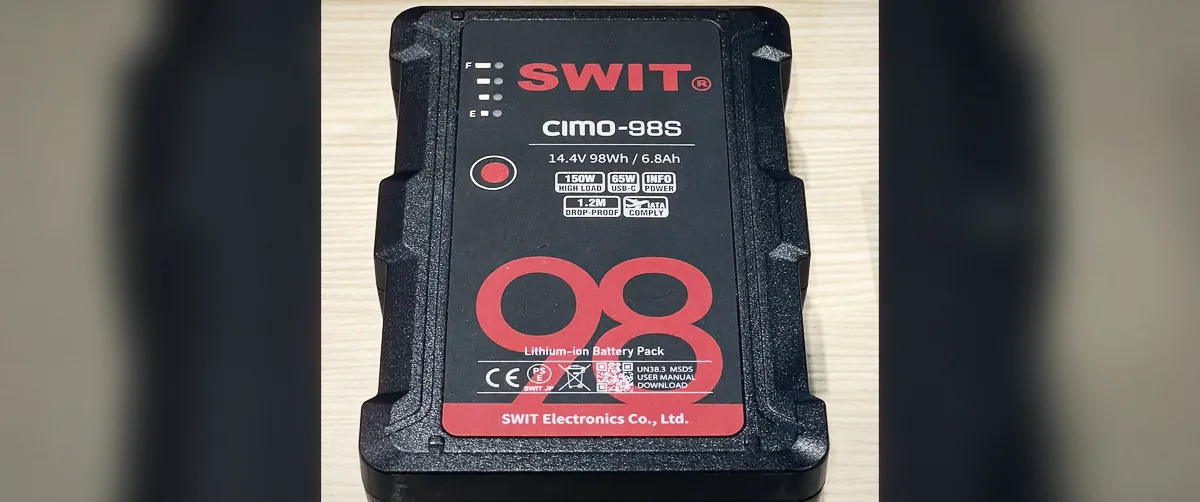
A 98Wh V-mount with a 65 W USB-C port: spare battery or power bank? Photo: TaurusEmerald (CC BY-SA 4.0), edited and graded by 4FILMMAKERS.
From 1 January 2027, the IATA Dangerous Goods Regulations (68th edition) list power banks over 100 Wh as forbidden on passenger aircraft. Spare lithium-ion batteries between 100 and 160 Wh can still fly in your carry-on, two per person, with the airline's approval. A 150Wh V-mount with USB-C and D-Tap outputs fits both descriptions, and the agent at the check-in desk decides which one it is.
ICAO started the split on 27 March 2026, with an addendum that separated power banks from spare batteries for the first time. That addendum still let passengers carry a 100-160 Wh power bank with airline approval. Four days later IATA told airlines it would drop that option from the 68th edition, and the passenger tables IATA has published for 2027 now put "Power banks exceeding 100 Wh" on the forbidden list. National rules can lag: the UK CAA's page on the change still describes the approval route as of 8 November.
What changes on 1 January 2027?
Most airlines work from IATA's Dangerous Goods Regulations, and IATA publishes a new edition every year. The 2026 edition (67th) runs until 31 December; the 68th applies from 1 January.
Lithium-ion batteries in passenger baggage, before and after the 68th edition
Battery
Until 31 Dec 2026
From 1 Jan 2027 (DGR 68)
Power bank up to 100 Wh
Carry-on only, max 2, no approval, no recharging on board (ICAO addendum)
Same (Table 2.3.B)
Power bank 100-160 Wh
The ICAO addendum allows it with airline approval; IATA's March guidance table already marks it forbidden
Forbidden (Table 2.3.C)
Spare battery up to 100 Wh
Carry-on only, up to 20 per person in IATA's March 2026 guidance
Carry-on only, up to 18 per person, airline can approve more (Table 2.3.B)
Spare battery 100-160 Wh
Carry-on only, max 2, airline approval
Same (Table 2.3.A)
Anything over 160 Wh
Not as passenger baggage, cargo only
Same
The 18 and 20 aren't a typo on our side. IATA's March guidance says 20 spares, and the 68th edition table says 18. Plan around the lower number.
IATA explains the reasoning in its guidance to airlines: cheap power banks come from makers with little regulatory oversight, and crew power banks were already capped at 100 Wh. Spare batteries built for one piece of equipment are less attractive to counterfeiters, so IATA left their rules alone.
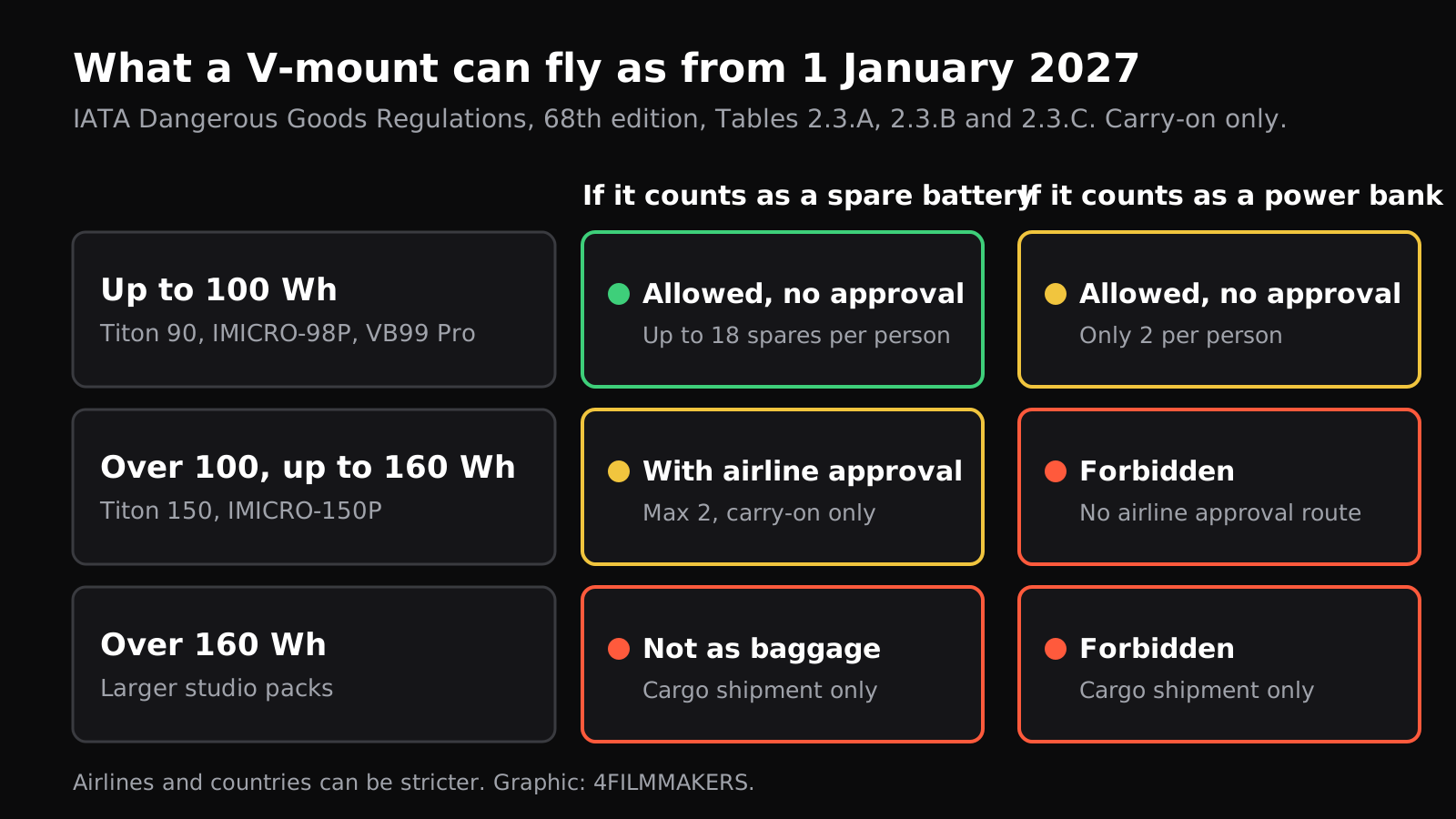
Is a V-mount a spare battery or a power bank?
IATA gives two definitions in its 2026 guidance. A power bank is "an easily carried universal external power source, capable of providing power to multiple devices". Spare batteries are single cells or multi-cell packs "designed to be inserted into or directly affixed to a specific device". A V-mount locks onto a camera, monitor or light plate, which reads like the second definition. It also has a D-Tap and often a USB-C PD port that will charge a phone or laptop, which reads like the first.
Neither IATA's power bank guidance nor the 2027 tables mention V-mount, Gold Mount or NP-F batteries. None of the battery makers we checked call their V-mounts power banks either. Our reading: a check-in agent who sees "Lithium-ion Battery Pack" on the label will treat it as a spare battery, and one who sees a USB-C port and a phone cable in your bag may not.
What makes a V-mount look like one or the other (our reading of IATA's definitions)
Points to "spare battery"
Points to "power bank"
Designed to lock onto a V-mount plate on a camera or light
USB-C PD or USB-A output that charges phones and laptops
Label says "Lithium-ion Battery Pack" with V, Ah and Wh
D-Tap output you can run any 12-14 V accessory from
Maker's documents call it a battery for professional video
Packed loose with charging cables, away from the camera
Travels with the camera body it powers
Marketing that calls it a "power station" or "power bank"
What do popular V-mounts say on the label?
Every V-mount below has a USB output. Watt-hours come from the makers' own pages, or from the label in our cover photo for the SWIT.
V-mount batteries checked on the makers' sites, 8 November 2026
Battery
Rating
Outputs
What the maker says about flying
From 2027
Anton/Bauer Titon 90
92 Wh
P-Tap, 5 V USB
Carry-on "subject to the prior approval of your airline"
Under 100 Wh
IDX IMICRO-98P
97 Wh
D-Tap, USB-C PD 60 W in/out
"meets the passenger aircraft carry-on limit"
Under 100 Wh
SWIT CIMO-98S
98 Wh (14.4 V, 6.8 Ah)
65 W USB-C, 150 W high load
"IATA comply" printed on the label
Under 100 Wh
SmallRig VB99 Pro Mini
98.87 Wh
2 x USB-C, USB-A, D-Tap
"Reisefreundlich" (travel-friendly) on SmallRig's German list page
Under 100 Wh
IDX IMICRO-150P
145 Wh
D-Tap, USB-C PD 60 W in/out
Same "carry-on limit" line, no word on approval
Spare: 2 with approval. Power bank: forbidden
Anton/Bauer Titon 150
144 Wh (spec table) or 156 Wh (range page)
P-Tap, 5 V USB
Carry-on with prior airline approval
Spare: 2 with approval. Power bank: forbidden
Anton/Bauer gives two different capacities for the Titon 150 on its own site. Both sit inside the 100-160 Wh band, but print the spec sheet that matches your label before you go to the airport. If a battery has no Wh figure, multiply volts by amp-hours: 14.4 V x 6.8 Ah is 97.9 Wh, which SWIT rounds to 98.
How many V-mounts can you take on a plane in 2027?
The same battery gets different limits depending on how the airline reads it. Graphic: 4FILMMAKERS, from IATA DGR 68 Tables 2.3.A to 2.3.C.
Typical travel kits under the 68th edition rules, carry-on only
Your kit
Read as spare batteries
Read as power banks
4 x 98 Wh
All four fly, no approval
Two fly, two stay behind
2 x 98 Wh
Both fly
Both fly, but you've used your power bank allowance; a phone power bank on top makes three
2 x 145-156 Wh
Both fly with written airline approval
Neither flies
3 x 145-156 Wh
Two with approval, the third can't fly
None fly
Any pack over 160 Wh
Cargo only
Cargo only
The two-pack kit is the one people miss. If an agent counts your 98Wh V-mounts as power banks, the slim USB-C bank in your jacket pocket puts you over the limit.
How should you pack a V-mount kit for a flight?
Put every V-mount in your carry-on. Spare batteries and power banks are banned from checked bags at any size.
Make the Wh rating easy to read. If the label has worn off, tape a printout of the spec sheet to the pack.
Protect the terminals. IATA asks for each battery to be protected against short circuits: the original pouch, terminal caps or one bag per battery.
For 100-160 Wh packs, ask the airline in writing before the trip. Give the make, model and Wh, and describe them as spare batteries for a professional video camera. IATA's guidance says an airline doesn't have to approve anything if the information is incomplete.
Bring the maker's UN 38.3 test summary. Anton/Bauer links one for each Titon model, SmallRig lists UN 38.3 among the VB99 Pro's certifications, and SWIT prints it on the CIMO-98S label.
Fly with the packs low. IATA's passenger guidance says airlines prefer spare batteries and power banks under 25%, so plan to charge at the hotel.
Don't run your phone off a V-mount during the flight. The rules forbid recharging a power bank on board, and IATA recommends against charging other devices from one in flight.
Check the airline that operates each leg, not only the one that sold the ticket. IATA's tables carry a note that states and airlines can set stricter limits, and CineD's May roundup lists stricter power bank rules at Lufthansa Group, Emirates, Singapore Airlines and the big US carriers. The airline battery pages we tried for this guide (Lufthansa, ITA Airways, easyJet, Air France-KLM, British Airways) wouldn't load from our server, so read them yourself before you book.
Does Europe follow the IATA date?
IATA writes an industry manual. The binding text comes from ICAO and from each country's authority, and IATA's own guidance says the timing depends on each state's process: some adopt changes at once, others need legislation. EASA's passenger page on lithium batteries, last updated in July 2025, still tells you to ask the airline for anything between 100 and 160 Wh. The UK CAA page keeps the approval route for 100-160 Wh power banks. In practice the airline applies its own manual at check-in, and most airlines follow the IATA DGR. Expect the stricter rule from January even where the national page hasn't changed yet.
Drone batteries are simpler. A DJI Intelligent Flight Battery fits one drone, so it reads as a spare battery; our DJI Mini 5 Pro EU guide covers the battery options for that model.
Should you switch to 98Wh batteries?
Our pick by how you work
If you
Do this
Why
Fly with your kit several times a year
Build the travel kit on 92-99 Wh V-mounts
No approval needed, and the power bank question only costs you if an agent counts them as power banks
Already own 145-156 Wh packs and fly in January
Take two at most, with written approval and the spec sheet
As spares they're legal; as power banks they're forbidden
Mostly drive to jobs
Keep the big packs
The 2027 change only touches air travel
Power a cinema rig all day abroad
Rent packs at the destination or ship them as cargo
Anything over 160 Wh can't go in passenger baggage
Carry a phone power bank too
Count it with your V-mounts
The limit is two power banks per person, of any size up to 100 Wh
Our view: if you're buying V-mounts now and you fly for work, buy sub-100 Wh. You lose about a third of the runtime of a 150Wh pack, and you take the approval step and the power bank argument off the table. If you're trimming a kit for flying, the same idea as our 82mm ND filter advice applies: one size that fits everything you carry.
Questions people ask
Can I take a 150Wh V-mount battery on a plane in 2027?
As a spare battery, yes: carry-on only, two per person, with the airline's approval. If the airline treats it as a power bank, no. From 1 January 2027 the IATA Dangerous Goods Regulations forbid power banks over 100 Wh on passenger aircraft.
Is a V-mount battery a power bank?
IATA doesn't say. Its guidance defines a spare battery as one designed to fit or attach to a specific device, and a power bank as a universal external source for several devices. A V-mount with USB-C and D-Tap outputs can be read either way, so the airline decides.
How many 99Wh V-mount batteries can I fly with?
As spare batteries, up to 18 per person under the 68th edition table, all in carry-on and without approval. Airlines can set lower limits. If they count as power banks, the limit is two.
Can I put V-mount batteries in checked luggage?
No. Spare lithium batteries and power banks are carry-on only at every size. A battery installed in a device can go in checked baggage under some conditions, but a loose V-mount is a spare.
Do I need airline approval for a 98Wh V-mount?
Not under the IATA tables: spare batteries and power banks up to 100 Wh need no approval. Some makers, Anton/Bauer among them, still tell you to check with the airline first, and individual airlines can add their own limits.