1-inch vs 1/1.1-inch sensor for video: what the size names really tell you
A 1/1.1-inch sensor isn't a 1-inch sensor. Real sizes, the Action 6, Osmo 360 II and Pocket 4P compared, and what the gap means for low light and depth of field.
A 1/1.1-inch sensor is smaller than a 1-inch sensor, even though the number looks bigger. By the usual naming rule, a 1/1.1-inch chip has about 17% less area than a 1-inch one, which is roughly a fifth of a stop of light. The gap that matters for video is the one to a 1/1.3-inch chip, because that's where the DJI Osmo Action 6, Osmo 360 II and Insta360 Ace Pro 2 split.
Why isn't a 1-inch sensor one inch?
The label comes from old video camera tubes. A tube with a one-inch glass envelope produced an image circle of about 16 mm, and when solid-state sensors arrived, anything that gave the same 16 mm diagonal was called "1-inch type". The name stuck and the units drifted away from reality.
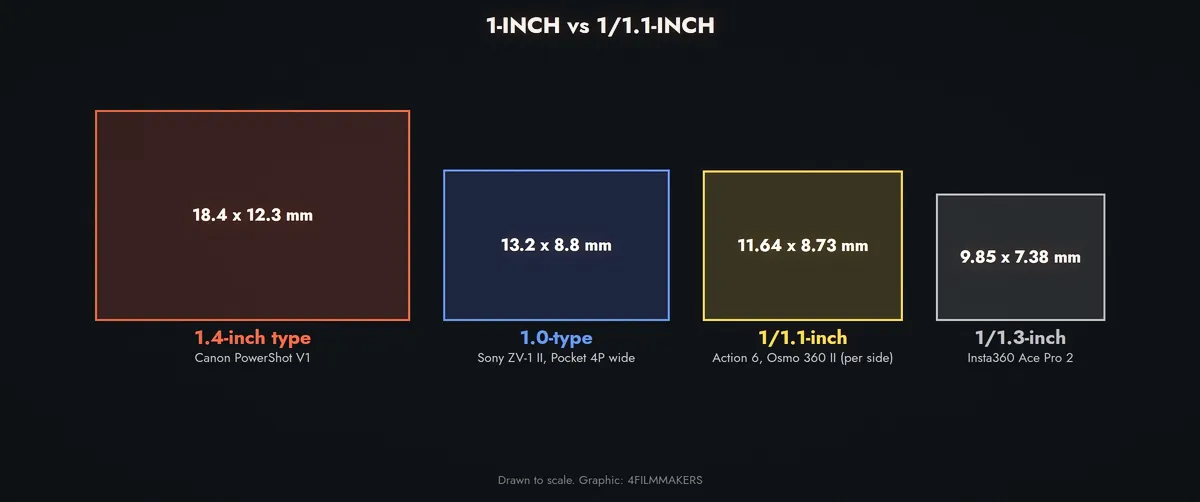
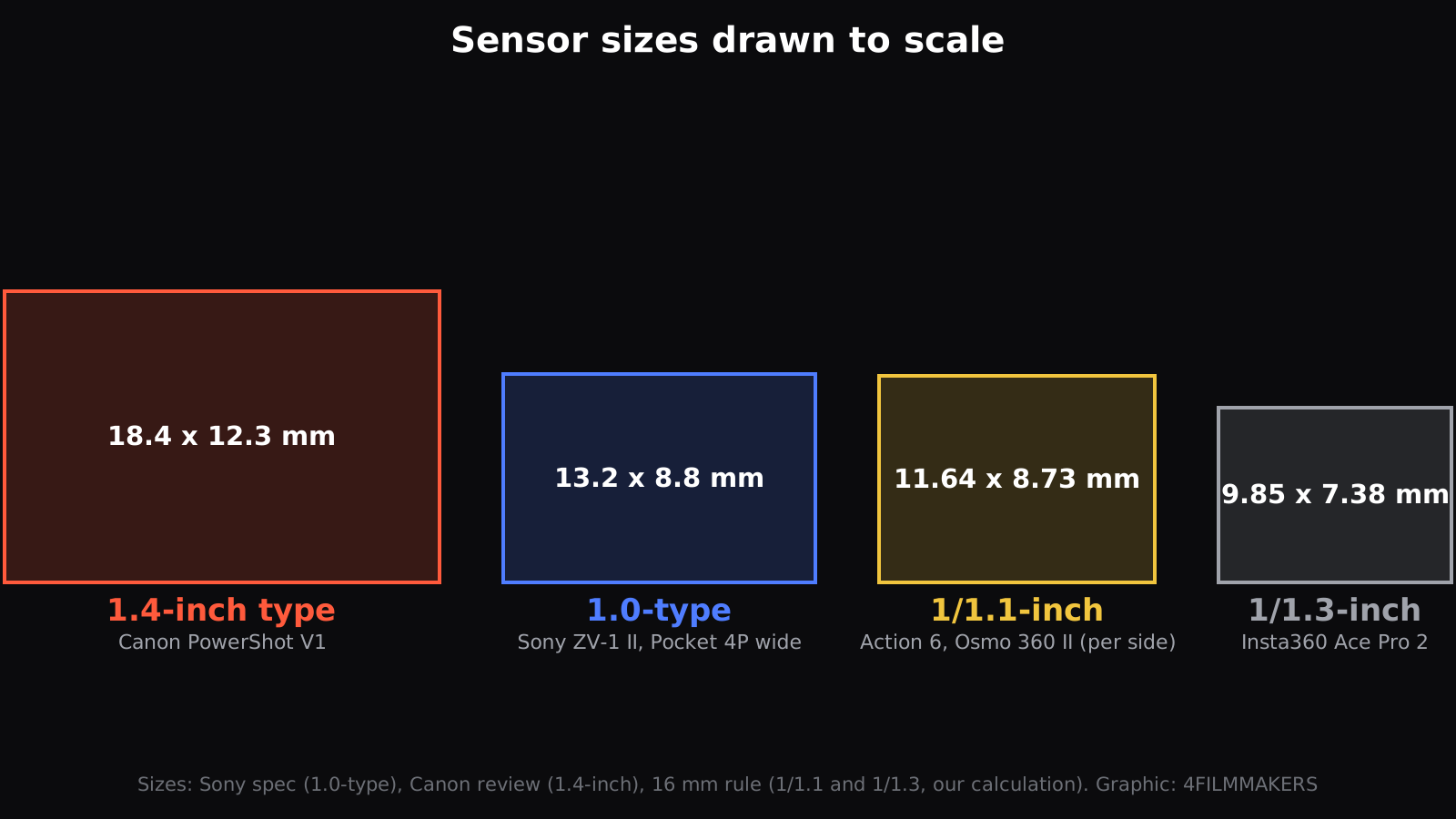
That gives a rule of thumb: the type number is a fraction of 16 mm, not of anything you can measure on the chip. A 1/1.1-inch sensor has a diagonal near 14.5 mm. A 1/1.3-inch sensor has one near 12.3 mm. Real chips vary a little, and makers rarely publish width and height, so treat the numbers below as good for ranking and not for measuring.
Drawn to scale. The 1/1.1 and 1/1.3 sizes come from the 16 mm rule, so they're approximate. Graphic: 4FILMMAKERS.
How much bigger is each sensor, in stops?
Area is what decides how much light the chip collects for a given lens. Each doubling of area is one stop. We worked these out from the sizes above.
Approximate sensor area and the gap to 1/1.3-inch
Sensor type
Size (mm)
Area
Versus 1/1.3-inch
1/1.3-inch
about 9.9 x 7.4
about 73 mm²
baseline
1/1.1-inch
about 11.6 x 8.7
about 102 mm²
+40%, about 0.5 stop
1.0-type (3:2)
13.2 x 8.8
about 116 mm²
+60%, about 0.7 stop
1.4-inch (Canon PowerShot V1)
about 18.4 x 12.3
about 226 mm²
+211%, about 1.6 stops
Half a stop is visible if you shoot a dim interior and compare clips side by side. It isn't the jump you get from going to a Micro Four Thirds or APS-C camera.
Which cameras use which size?
Sensor and lens figures from the makers' spec pages
Camera
Sensor
Lens
Claimed dynamic range
DJI Osmo Pocket 4P (wide)
1-inch, LOFIC
20mm equiv., f/2.0
17 stops
DJI Osmo Pocket 4P (tele)
1/1.28-inch
60mm equiv., f/1.8
not separate
DJI Osmo Action 6
1/1.1-inch, 2.4 µm pixels
f/2.0 to f/4.0, 155° field of view
13.5 stops
DJI Osmo 360 II
Two 1/1.1-inch square, 2.4 µm pixels
f/1.9
14.5 stops
Insta360 Ace Pro 2
1/1.3-inch
f/2.6
13.5 stops
Sony ZV-1 II, RX100 VII
1.0-type, 13.2 x 8.8 mm
zoom lens
not published
Canon PowerShot V1
1.4-inch, about 22.3 MP
zoom lens
not published
The Osmo 360 II's DJI support page says each of its two sensors has an imaging area equal to a 1-inch 4:3 sensor. A 1/1.1-inch chip by the naming rule comes out smaller than that, so the two statements don't line up on paper. Fstoppers also notes that the sensor looks identical to the one in the first Osmo 360, so the jump from 13.5 to 14.5 stops likely comes from processing. We can't resolve this without published sensor dimensions.
Pixel size doesn't separate these cameras either. DJI quotes 2.4 µm for the Action 6 and the Osmo 360 II, and Insta360 quotes 2.4 µm "equivalent" for the Ace Pro 2. Area does the work, not the pixel pitch on the box.
Do you really get the whole sensor in video?
Often not. The Action 6 records 4K at 4:3 (3840 x 2880) and also a square 3840 x 3840 mode, so those frames use the full height of the chip. A normal 16:9 frame cuts the height by a quarter. If it keeps the full width, which DJI doesn't spell out, the Action 6 in 16:9 uses about 76 mm², close to the whole area of a 1/1.3-inch sensor.
The Canon PowerShot V1 shows the reverse. Its 4K 30p uses the full width of the 1.4-inch chip, but Canon lists a 1.4x crop at 4K 60p. Divide the area by 1.96 and you get about 115 mm², the size of a 1-inch sensor. The big sensor is only there when you shoot 30p.
So before you pay extra for a bigger sensor, check what the mode you'll actually shoot in uses. Frame rate, aspect ratio and stabilisation crop all take bites out of it. Our Pocket 4P ND filter guide covers one more place where the sensor decides your gear: ISO 1600 in D-Log 2 changes which filters you need.
What does sensor size change for depth of field?
Smaller sensors keep more of the scene sharp at the same field of view. Multiply the aperture by the crop factor to compare with full frame. These are our calculations from the quoted f-numbers and the 16 mm rule.
Full-frame equivalent aperture, approximate
Camera
Real aperture
Equivalent
Pocket 4P wide (1-inch)
f/2.0
about f/5.5
Pocket 4P tele (1/1.28-inch)
f/1.8
about f/6.2
Action 6 (1/1.1-inch)
f/2.0 to f/4.0
about f/5.9 to f/11.9
Ace Pro 2 (1/1.3-inch)
f/2.6
about f/9.1
None of these will give you the soft backgrounds of a full-frame camera. The 1-inch Pocket 4P and the 1/1.1-inch Action 6 land in the same band, f/5.5 against f/5.9 wide open. The Action 6 stops down to f/4.0, which pushes it past f/11 in the same terms. The Ace Pro 2 sits well behind both.
Which size is the right one for you?
Our reading of the numbers, not a test result
If you shoot...
Look at
Why
Mostly daylight, vlog or travel
Any of them
Half a stop rarely shows in good light.
Evening street or interiors
1-inch Pocket 4P or a 1.0-type compact
You gain 0.2 to 0.7 stop and a lower noise floor.
Action footage at 4K 120p
Action 6 in 4:3
The 4K 4:3 mode at 100 and 120 fps uses the full sensor height.
360 reframing
Osmo 360 II
Two 1/1.1-inch sensors, 14.5 stops claimed.
A cheap small action cam
1/1.3-inch cameras
Good enough in light, behind in low light by about half a stop.
If the Action 7 rumors are right about a bigger sensor, this arithmetic is what to check the claim against. We covered what's reported so far in our Osmo Action 7 rumors piece.
Questions people ask
Is 1/1.1-inch bigger than 1-inch?
No. The fraction is of a 16 mm reference, so 1/1.1-inch is about 14.5 mm across the diagonal and 1-inch is about 16 mm. The 1/1.1-inch sensor has roughly 14% less area than a 1.0-type one.
How much better is 1/1.1-inch than 1/1.3-inch?
About 40% more area, which is about half a stop of light. It helps in dim scenes. In daylight it's hard to see.
What are the exact dimensions of a 1/1.1-inch sensor?
DJI doesn't publish them for the Action 6. About 11.6 x 8.7 mm is our figure from the naming rule, so treat it as approximate. DJI's support page says each Osmo 360 II sensor equals a 1-inch 4:3 sensor, which would be bigger.
Does a bigger sensor mean more dynamic range?
Not on its own. The Pocket 4P is rated 17 stops with a 1-inch LOFIC sensor, the Osmo 360 II 14.5 stops and the Action 6 and Ace Pro 2 13.5 stops. These are makers' claims measured their own way, and readout design matters as much as size.
Sources
DJI Osmo Action 6 specs and FAQ (dji.com): 1/1.1-inch sensor, f/2.0 to f/4.0, 4K 4:3 and 3840 x 3840 modes, 2.4 µm pixels, 13.5 stops
DJI Osmo 360 II specs and support page (dji.com), plus PetaPixel, CineD and Fstoppers coverage: dual 1/1.1-inch square sensors, 14.5 stops
DJI Osmo Pocket 4P specs as reported by DroneXL, PetaPixel and heliguy: 1-inch wide camera, 1/1.28-inch tele, 17 stops claimed